Christopher Reeves Till We Meet Again
| Somewhere in Fourth dimension | |
|---|---|
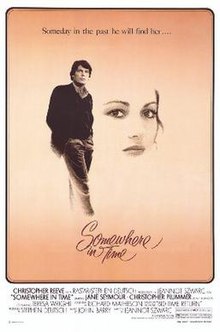 Theatrical film poster | |
| Directed by | Jeannot Szwarc |
| Screenplay by | Richard Matheson |
| Based on | Bid Time Return by Richard Matheson |
| Produced by |
|
| Starring |
|
| Cinematography | Isidore Mankofsky |
| Edited by | Jeff Gourson |
| Music by | John Barry |
| Production | Rastar |
| Distributed by | Universal Pictures |
| Release date |
|
| Running time | 103 minutes |
| Country | U.s.a. |
| Language | English |
| Budget | $4 one thousand thousand[ane] |
| Box office | $nine.7 million |
Somewhere in Fourth dimension is a 1980 American romantic fantasy drama film from Universal Pictures, directed past Jeannot Szwarc, and starring Christopher Reeve, Jane Seymour, and Christopher Plummer. It is a film accommodation of the 1975 novel Bid Time Return by Richard Matheson, who also wrote the screenplay.
Reeve plays Richard Collier, a playwright who becomes obsessed with a photograph of a immature woman at the Grand Hotel on Mackinac Isle, Michigan. Through cocky-hypnosis, he wishes himself back in fourth dimension to the year 1912 to discover dear with actress Elise McKenna (portrayed by Seymour), simply comes into conflict with Elise's managing director, William Fawcett Robinson (portrayed by Plummer), who fears that romance will derail her career, and resolves to stop him.
The picture is known for its musical score composed by John Barry, featuring pianist Roger Williams. The 18th variation of Sergei Rachmaninoff's Rhapsody on a Theme of Paganini also appears several times.
Plot [edit]
In 1972, higher theater student Richard Collier celebrates the debut of his new play. An elderly woman Richard does not know comes upwardly and places a pocket watch in his hand and pleads, "Come up back to me". The woman returns to her home and dies in her slumber that night.
Eight years later, Richard is a successful playwright living in Chicago. While struggling with writer'south block, he decides to take a break from writing and travels to a resort, the Grand Hotel. While exploring the hotel's hall of history, he becomes enthralled with a vintage photo of Elise McKenna, a beautiful early-20th century stage actress. Upon further inquiry, he discovers she is the aforementioned adult female who gave him the pocket picket. Richard visits Laura Roberts, Elise's former housekeeper and companion. While in that location, he discovers a music box that plays the 18th variation of Rhapsody on a Theme of Paganini by Rachmaninoff, his favorite musical slice. Amid Elise's personal effects is a volume on time travel written by his one-time higher professor, Dr. Gerard Finney. Richard becomes obsessed with traveling dorsum to 1912 and meeting Elise, with whom he has fallen in love.
Richard seeks out Professor Finney, who believes that he briefly time-traveled through the power of self-suggestion. Finney warns Richard that such a process would exit one very weak physically, perhaps dangerously so. Richard is determined to try. Dressed in an early 20th-century conform, he removes all modern objects from his hotel room and attempts to will himself to 1912 using tape-recorded suggestions. The attempt fails because he lacks real conviction, only after finding a hotel guest book from 1912 containing his signature, Richard realizes that he will somewhen succeed.
Richard hypnotizes himself over again, this time allowing his absolute faith in his eventual success to serve as the engine that transports him to 1912. Richard finds Elise walking by the lake. Upon coming together him she asks, "Is it you?" Her manager, William Fawcett Robinson, abruptly intervenes and sends Richard away. Although Elise is initially uninterested, Richard pursues her until she agrees to back-trail him on a stroll the next morning. During a boat ride, Richard hums his favorite tune by Rachmaninoff, which Elise has not heard before because it has nonetheless to be written. Richard asks what Elise meant by "Is it you?" She reveals that Robinson had predicted that she would see a human who will change her life, and that she should be afraid. Richard shows Elise the pocket lookout man that she will give him in 1972.
Richard attends Elise's play where she recites an impromptu romantic monologue while making eye contact with him in the audience. During the pause, Elise poses formally for a photograph, but upon seeing Richard, breaks into a radiant smile. It is the same epitome which Richard sees 68 years subsequently. Afterward, Richard receives an urgent message from Robinson requesting a meeting. Robinson wants Richard to go out Elise, proverb it is for her own good. Richard thinks Robinson is in dear with Elise, but Robinson states he is obsessed with her being a star and has no romantic interest in her. When Richard declares his intention to stand past Elise for the rest of her life, Robinson has him bound and locked inside the stables. Robinson then tells Elise that Richard has left, though she does not believe him and professes her love for Richard.
Richard wakes the next morning and frees himself. The acting troupe has already left for Denver, though Elise has returned to the hotel to find him. They go to her room and make love. They concord to ally and Elise promises to buy Richard a new suit, as his is almost a decade out of way. Within one of the suit pockets, Richard discovers a penny with a 1979 mint date. This modern detail breaks the hypnotic suggestion, pulling Richard into the nowadays as Elise screams in terror.
Richard awakens back in 1980, physically weakened past the time travel. His attempts to return to 1912 are unsuccessful. After despondently wandering the hotel grounds for weeks without eating, he dies in despair, despite Arthur'south efforts to call paramedics to salvage him. Richard'south spirit then joins Elise in the afterlife.
Cast [edit]
- Christopher Reeve as Richard Collier
- Jane Seymour equally Elise McKenna
- Christopher Plummer as William Fawcett Robinson
- Teresa Wright as Laura Roberts
- Bill Erwin as Arthur Biehl
- Sean Hayden equally 5-twelvemonth-old Arthur in 1912
- George Voskovec as Dr. Gerard Finney
- Susan French as Older Elise
- John Alvin every bit Arthur'due south father
- Eddra Gale equally Genevieve
- Tim Kazurinsky as a photographer in 1912
- William H. Macy as a critic in the 1972 scene (earlier Elise hands the watch to Richard)
- Don Franklin as tourist in Hall of History #2
Richard Matheson, who wrote the original novel and screenplay, appears in a cameo role as a 1912 hotel guest. He is astonished by Richard'due south having cutting himself shaving with a straight razor. Richard Matheson's daughter, Ali, is similarly credited as a student.
George Wendt is credited equally a student during this aforementioned scene, but his appearance was cutting from the film during editing.
Production notes [edit]
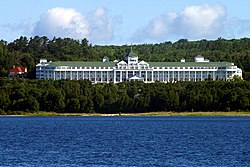
The Grand Hotel where the flick was shot
- The film was shot on location at the Grand Hotel, as well as the Mission Point Fine Arts building of the erstwhile Mackinac College (at present Mission Point Resort), both located on Mackinac Isle, Michigan. Additional scenes were filmed in Chicago, Illinois.
- Bringing cars onto the isle for utilise in the film required special permission from the Urban center of Mackinac Island. Motorized vehicles, other than emergency vehicles and snowmobiles in the winter, are prohibited on the Island. With very few exceptions, transportation is express to horse and buggy or bicycle.
- Managing director Jeannot Szwarc had a slight problem directing the scenes betwixt Plummer and Reeve in that whenever he said "Chris," both men would respond with "Aye?" Szwarc resolved this by addressing Plummer equally "Mr. Plummer" and addressing Reeve as "Bigfoot".
- The concluding scene between Christopher Reeve and Jane Seymour earlier Reeve'due south character is thrown back into his ain time was difficult for Reeve to shoot, as he had only learned that his girlfriend and companion, Gae Exton, was pregnant with his first son Matthew. For much of that day his attention was understandably elsewhere. Reeve says on the bonus material of the 2000 DVD, "The day nosotros shot the picnic scene on the floor I plant out, and the world found out, that I was about to be a begetter for the first time".
- In the film, Reeve's graphic symbol consults with a Dr. Finney (played by George Voskovec), a time travel theorist. This is a deliberate nod to writer Jack Finney, whose novel Time and Again, published five years before Richard Matheson's 1975 novel Bid Fourth dimension Return, on which this movie is based, features an almost identical theory on the mechanics of fourth dimension travel.
- Elise McKenna was a fictional actress. Collier is filmed in the library searching and looking through an old theater album, which has photos of historic stage actresses. The 3 little girls are Blanche Ring and her sisters. A child property a doll is actress Rose Stahl. A faded pic of a woman in nun's addiction is Ethel Barrymore in a 1928 play, The Kingdom of God. (Barrymore's head is left out of the frame as she would exist readily recognizable by alert fans of old films.)[two]
- Elise McKenna's character was loosely based upon the life of theatre actress Maude Adams, who was born Maude Ewing Adams Kiskadden in Salt Lake City, Utah on November 11, 1872. She died in Tannersville, New York on July 17, 1953. Her manager, Charles Frohman (the ground for the William Fawcett Robinson graphic symbol) was very protective of her. He died on the RMS Lusitania on May 7, 1915, when the body of water liner was torpedoed past a German submarine during Globe War I.[3]
- At two points in the moving-picture show, Christopher Reeve is seen listening to the radio; first while driving northbound on Lake Shore Drive in Chicago; then when Reeve returns to the present and turns on the radio in his room at the Thousand Hotel. In both instances, the radio announcer is Reese Rickards, a long-fourth dimension fixture at Chicago AM radio station WJJD. While the film portrays the radio station as having a jazz format, Rickards plays an actual jingle from WJJD which was a country station at that fourth dimension.
Differences from the novel [edit]
In the novel, Richard travels from 1971 to 1896 rather than from 1980 to 1912. The setting is the Hotel del Coronado in California, rather than the Yard Hotel in Michigan. The book has Richard knowing that he is dying of a brain tumor, and information technology ultimately raises the possibility that the whole time-traveling experience was merely a serial of hallucinations brought on past the tumor.
The scene where the old woman hands Richard a pocket watch (which he had given to her in the past) does not announced in the book. Thus, the ontological paradox generated by this event (that the watch was never made, only simply exists eternally between 1912 and 1980) is absent. In the book, in that location are ii psychics, not William Fawcett Robinson, who anticipate Richard's appearance, and Richard'due south death is brought about by his tumor, not by heartbreak.
Also, in the film, Elise witnesses Richard's return to his ain time, while in the volume she is asleep and does non.
Reception [edit]
Although the film was well received during its previews, it was derided by critics upon release and under performed at the box part. In 2009, in an interview with WGN America, Jane Seymour stated "It was merely a little picture... The Blues Brothers came out the same week, and [Somewhere In Fourth dimension] was a $4 million budget, so Universal didn't really support it. There was too an actors' strike, then Chris [Reeve] and I weren't allowed to publicize it. And they barely put information technology out because I don't retrieve anyone actually believed in it."[4]
Critical response [edit]
Film review aggregator Rotten Tomatoes reports that 58% of 19 flick critics have given the film a positive review; the rating average is 6 out of 10.[5] Metacritic, which assigns a weighted average score out of 100 to reviews from mainstream critics, gives the picture show a score of 29 based on 7 reviews, signifying "Generally unfavorable reviews".[half dozen]
Accolades [edit]
Somewhere in Time received several awards, including Saturn Awards for Best Costume, Best Music, and Best Fantasy Motion-picture show. The film was also nominated for the Academy Honour for Best Costume Design (Jean-Pierre Dorleac).[7]
The film is recognized by the American Film Institute in these lists:
- 2002: AFI'due south 100 Years...100 Passions – Nominated[eight]
- 2005: AFI's 100 Years of Picture show Scores – Nominated[9]
Soundtrack [edit]
The film'southward original musical score was composed and conducted by John Barry, who was suggested by Jane Seymour, a personal friend. The producers had been because a score based on The 18th variation of Sergei Rachmaninoff's "Rhapsody on a Theme of Paganini". which is used in the picture show several times. In lieu of a fee, Barry took a percentage of the royalties on the soundtrack, which went on to get his best-selling picture show score.[10] [11]
The film was not a success at the box office and a very express run above promotional copies of the album was pressed with very limited circulation. Universal Pictures used "Somewhere in Time" as a test bed for soundtrack sales and did non expect it to practice well at all. It was cable tv the following spring where the film garnered a huge fan audience and interest in the music was tremendous. So many requests were fabricated at record stores across the country that Universal pressed 500,000 more copies and the soundtrack, now into several pressings, still sells well on compact disc. The music became one of the most requested at weddings for a decade after the pic'southward release.
Barry wrote the score at a creative and prolific time in his career, scoring the music for films such as Raise the Titanic, High Route to China, and the highly acclaimed Body Estrus, all within an 18-calendar month period. Yet the score for Somewhere in Time is considered to be among the best of his career. The music from the film is often credited for much of its success by invoking a securely emotional pull for the viewers. In the years since the film's release, the music has go as famous as the film, if non more then, with many hearing information technology and then seeking the film on video.
Bruce Handy for Vanity Fair described the development of Barry's scoring style after moving to Hollywood in 1975 as "the liquid orchestral style that would be epitomized past his music for Somewhere in Time, a 1979 time-travel romance starring Christopher Reeve and Jane Seymour."[12]
The music has been released on ii albums, neither of which are from the original sessions from the movie itself. Like most soundtracks of the time, the album was a series of re-recordings with highlights of the score recorded to fit onto ii sides of an LP. The original release from MCA Records has 9 tracks.
- Somewhere in Time (two:58)
- The Old Woman (2:49)
- The Journeying Back in Time (4:22)
- A Day Together (six:02)
- Rhapsody on a Theme of Paganini (composed by Rachmaninov) (2:57)
- Is He the One? (3:10)
- The Man of My Dreams (1:35)
- Return to the Present (four:04)
- Theme from "Somewhere in Time" (3:20)
A later on release of the score was released on the Varèse Sarabande label. It was recorded in 1998 by the Royal Scottish Orchestra conducted by John Debney.
- Somewhere in Time (3:37)
- Old Woman (one:00)
- Grand Hotel (i:22)
- 1912 (1:42)
- Thanks (i:20)
- June 27 (1:32)
- Room 417 (1:04)
- The Attic (4:07)
- Well-nigh the Lake (ii:14)
- Rhapsody on a Theme of Paganini (equanimous by Rachmaninov) (three:06)
- Is He the One? (0:56)
- A Day Together (two:31)
- Rowing (1:29)
- The Human of My Dreams (1:22)
- Razor (1:12)
- Total Dismay (4:07)
- Money (0:28)
- Whimper (3:20)
- Somewhere in Time (end credits) (4:55)
On July xiii, 2021, a limited edition album was released by La-La Land Records with an expanded presentation of Barry's music. Tracks one-17 are presentation of the score, followed past source music and alternates.[13]
- Theme from Somewhere in Fourth dimension - Performed by Roger Williams; Produced by Michael Lloyd 3:26
- The Chiliad Hotel 2:04
- Rhapsody on a Theme of Paganini (Pianoforte Solo by Chet Swiatkowski) two:54
- The Sometime Woman (Film Version) 2:49
- June 27 2:03
- Room 417 ane:xi
- The Journeying Back in Time 4:29
- Is He the One? (Pic Version) three:13
- A Day Together (Film Version) 2:31
- Rowing one:xv
- The Homo of My Dreams i:42
- That'southward It :xl
- Razor 1:05
- Total Dismay 3:21
- Coin :37
- Render to the Present four:10
- A Twenty-four hours Together (End Credits) 6:08
- After Party 2:03
- Car Jazz ii:00
- Rhapsody on a Theme of Paganini (Alternate) - Pianoforte Solo past Chet Swiatkowski iii:03
- Rhapsody on a Theme of Paganini (Music Box) 2:11
- Is He the One? (Alternate Excerpt) two:21
- My Melancholy Baby 2:02
- Oh, Y'all Beautiful Doll 3:30
- In the Skillful Erstwhile Summer Time :37
- I Want a Girl (Just Like the Girl That Married Dear Old Dad) 1:53
- Wisdom of the Center 1:09
- Somewhere in Fourth dimension (Piano Theme) i:59
- Rowing (Alternate) 1:xviii
- Razor (Alternate) :51
- Coin (Alternate) :32
- Somewhere in Time (Theme Variation) 1:46
- Finale and End Credits (From the Motility Moving picture Somewhere in Time) 4:57
Tracks in bold are previously unreleased. Tacks in italics incorporate previously unreleased material.
Certifications [edit]
Legacy [edit]

A stone monument located at one of the filming locations
Despite reviews calling the film "horrible" and a "superficial tear jerker", the International Network of Somewhere In Time Enthusiasts (I.N.S.I.T.E.), an official fan club, was formed in 1990 and continues to see regularly.[xvi] During the month of Oct, the K Hotel hosts a Somewhere in Time Weekend, with events such every bit a big-screen screening of the film, console discussions with some of the picture'due south principals and coiffure, and a costume brawl of members dressed in Edwardian attire.[17]
The film was besides listed as an example of popular culture fourth dimension travel in the blockbuster moving picture Avengers: Endgame (2019).[18]
| | This section needs to be updated. (July 2020) |

Adding to the picture's legacy is a Ken Davenport-produced theatrical adaptation of the story with assistance from Matheson on the story book.[19] [20] The adaptation received New York workshops and a full production at Portland Middle Stage.[21] [22] [23]
Encounter likewise [edit]
- The Two Worlds of Jennie Logan
- List of films featuring time loops
References [edit]
- ^ On Location With Christopher Reeve: iii Chocolates on the Pillow 'To Escape the Greatcoat' Crew Works for Scale
- ^ Blum, Daniel. Keen Stars of the American Phase, c.1952. All of these photos are in Blum's book.
- ^ Robbins, Phyllis (1956), Maude Adams: An Intimate Portrait, New York: G.P. Putnam's Sons .
- ^ Interview with Jane Seymour (video) on YouTube
- ^ "Somewhere in Fourth dimension Moving picture Reviews, Pictures". Rotten Tomatoes . Retrieved November iii, 2021.
- ^ "Somewhere in Time Reviews, Ratings, Credits, and More – Metacritic". Metacritic. CBS Interactive Inc. Archived from the original on 10 September 2010. Retrieved March 14, 2013.
- ^ "The 53rd Academy Awards (1981) Nominees and Winners". Oscars.org. University of Movement Film Arts and Sciences. Archived from the original on 10 Nov 2014. Retrieved March xiv, 2013.
- ^ "AFI's 100 Years...100 Passions Nominees" (PDF). AFI. Archived from the original (PDF) on Oct 24, 2018. Retrieved August 19, 2016.
- ^ "AFI's 100 Years of Film Scores Nominees" (PDF). AFI. Archived from the original (PDF) on July 14, 2019. Retrieved Baronial 19, 2016.
- ^ Somewhere in Time [Original Motion Picture show Soundtrack] - John Barry | Songs, Reviews, Credits | AllMusic , retrieved 2022-03-21
- ^ "Somewhere in Time". TVGuide.com . Retrieved 2022-03-21 .
- ^ "John Barry: The Man Who Knew the Score". Vanity Fair. 2009-01-08. Retrieved 2022-03-21 .
- ^ "Somewhere in Time: Limited Edition".
- ^ "Brazilian album certifications – John Barry – Somewhere In Time" (in Portuguese). Pro-Música Brasil.
- ^ "American album certifications – John Barry – Somewhere In Time". Recording Industry Association of America.
- ^ Slater, Eric (May 14, 1995). "Fans of 1980 'Tear-Jerker' Gloat Picture show : Entertainment: Devotees of 'Somewhere in Time' gather in Universal City to accolade movie equally the tiptop of romance cinema". Los Angeles Times . Retrieved May 20, 2015.
- ^ Storch, Charles (October 23, 1992). "'Somewhere In Time' Travelers: Fans Of Cult Romance Movie Descending On Mackinac Isle To Wallow In The Fantasy". Chicago Tribune. Chicago Tribune. Retrieved May 26, 2015.
- ^ Petrakovitz, Caitlin. "Answering the large questions near that major Avengers: Endgame plot indicate". CNET . Retrieved 1 August 2020.
- ^ Cox, Gordon (March seven, 2006). "'Somewhere' rights nabbed by Davenport". Multifariousness. Variety. Retrieved May 27, 2015.
- ^ Hoffman, Barbara (April 15, 2012). "Blockbusters go Broadway". New York Mail service . Retrieved May 27, 2015.
- ^ Hetrick, Adam (December 4, 2012). "Somewhere in Time Musical Reading to Feature Andrew Samonsky and Kelli Barrett". Playbill . Retrieved 27 September 2020.
- ^ Hetrick, Adam (February 5, 2015). "Somewhere in Fourth dimension Musical, With Laura Osnes and Ryan Silverman, Begins NYC Workshop". Playbill . Retrieved 27 September 2020.
- ^ Hetrick, Adam (Apr 24, 2013). "Andrew Samonsky Steps Into Leading Part of Somewhere in Time Musical". Playbill . Retrieved 27 September 2020.
External links [edit]
- Somewhere in Time at the American Movie Plant Catalog
- Somewhere in Time at IMDb
- Somewhere in Time at AllMovie
- Somewhere in Time at Box Office Mojo
- Somewhere in Time at Rotten Tomatoes
- Somewhere in Time at the TCM Pic Database
adamsfrouninclues.blogspot.com
Source: https://en.wikipedia.org/wiki/Somewhere_in_Time_(film)
0 Response to "Christopher Reeves Till We Meet Again"
Post a Comment