Anti Federalists Vs Federalists Federalists Vs Anti Federalists Clip Art


Topics on the Folio
Overview of the Debate
Federalists
- Alexander Hamilton
- James Madison
- John Jay
Anti-Federalists
- George Mason
- Robert Yates
- Patrick Henry
- Mercy Otis Warren
Differences Over the Constitution
The Federalist Papers
Notable Topics in the Federalist Papers
- Factions
- Checks and Balances
- An Contained Judiciary
States Rights vs. Federal Ability in Mod-Day Environmental Policy

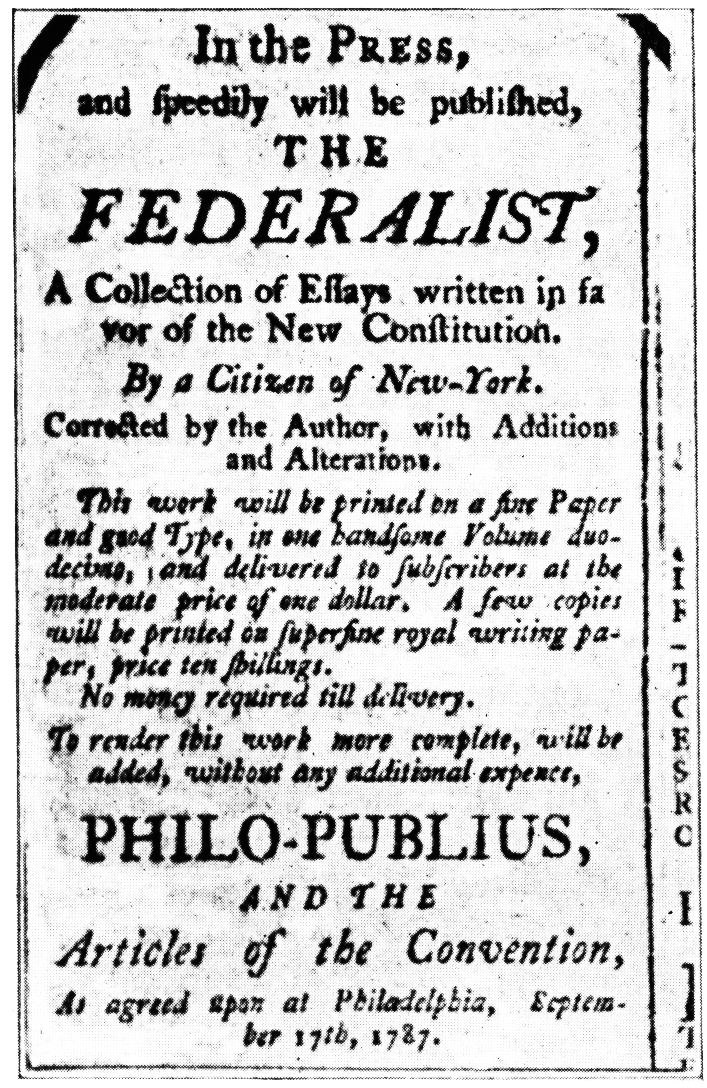
An Advert of The Federalist - Projection Gutenberg eText
Focus Questions:
-
What were the key points of debate betwixt Federalists and Anti-Federalists?
-
Why were the cardinal ideas within the Federalist Papers then of import?

-
Seminal Primary Documents to Read: Federalist Newspaper number 10
-
Seminal Master Documents to Consider:
-
Federalist Papers Numbers 1, 9, 39, 51, and 78
- The Federal Farmer I (Oct eight, 1787)
Hither is a crash course video Giving an overview of the Constitutional Convention as well every bit Federalists vs. Anti-Federalists.
Differences between Federalists and Anti-Federalists
The debate over the ratification of theU.S. Constitution is known for the sharp divide it created among the newly independent states.
- The Manufactures of Confederation were in place, and many of those in charge began noticing several flaws inside the Articles.
- The government that it created was weak and many saw a demand for a stronger federal government. The Constitution was thus proposed, created, and sent to u.s.a. for ratification.
- The Federalists and the Anti-Federalists emerged with the Federalists arguing for ratification and the Anti-Federalists, for numerous reasons, arguing confronting the ratification.
- The carve up was intense and in most states, ratification just barely happened.
- It did happen, however, in all thirteen states but the contend over it lasted for years and has been used over and over again to assistance testify only how some of these founding fathers actually interpreted what was existence said in the Constitution and their actual intentions.
Click here for a video explaining the debate between the Federalists and Anti-Federalists in a very entertaining fashion.
 |
| John Jay |
Federalists
The Federalists were a group of thinkers and people loyal to the conventionalities that a modify was needed from the Articles of Confederation, and that change was the Constitution.
- The Manufactures created a weak key authorities and left a lot of the power in the hands of the state governments.
- The Constitution on the other hand created a strong key government with weaker but still constructive state governments.
- The Federalists desired this and began to argue for its ratification.
- Notable Federalists included, Alexander Hamilton, James Madison and John Jay who all contributed to the Federalist Papers nether the pseudonym Publius.
- George Washington was also a known supporter of ratification and can exist seen every bit the driving equus caballus backside his home state, Virginia, ratifying it.
 Link hither for a brusque biography of Alexander Hamilton and his wife, Elizabeth Hamilton
Hither is a short Biography on James Madison including a short video clip.
Anti-Federalists
The Anti-Federalists came on to the scene merely as quickly as the Federalists did. They saw the Constitution equally a change to everything they had worked for. The Articles created a weak cardinal regime because the colonists were sick of a potent cardinal government which they witnessed in England.
George Clinton

- They thought that this change would mean the U.South. would be heading in the direction of a monarchy. The ability of the presidency alone was plenty to brand them think that a monarchy would be established. They favored states rights and believed that was the original intention of the Revolution.
- Each of the thirteen states had a potent anti-federalist faction within, and ratification of the Constitution proved extremely difficult considering of that. Luckily for anybody, some of their qualms were resolved including the Bill of Rights.
- Some key Anti-Federalists included George Clinton, Robert Yates and Samuel Bryan who all about likely contributed to the Anti-Federalist papers.
- Other opponents of ratification included one of the first to speak out publicly, Patrick Henry, along with several important figures under the Articles of Confederation.
- The Anti-Federalists had just as much of a chance to win and it was because of that defeat that many of them are not nearly also known as those involved with the Federalists.
The Antifederalists: The Other Founders of the American Constitutional Tradition?
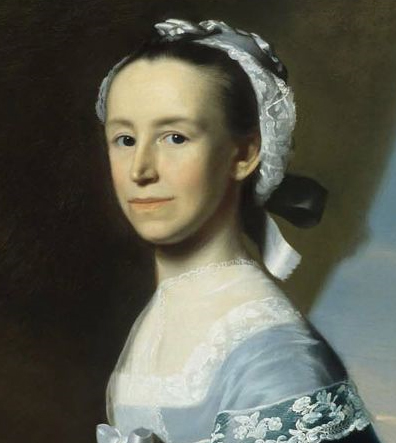

Mercy Otis Warren
Anti-Federalist Mercy Otis Warren wrote many political pieces nether the pseudonym "A Columbian Patriot' in support of the Ant-Federalist ideals
- She was likewise from Barnstable/Plymouth Massachusetts, making her an of import figure for both New England and Massachusetts history as well.
- Link to her story based in MA.
About the Correspondence Between John & Abigail Adams, Massachusetts Historical Society
The Debate over the Ratification of the Constitution
Once ratification was proposed and the two sides formed, the debate began. Information technology took a little while longer for the Anti-Federalists to come out publicly, just each state witnessed an intense battle between two completely different sides.
- The Federalists were arguing for the alter. They did non want a organization where each of the land governments would be rivaling one some other for the control.
- They needed a central authorities that would maintain the union. The Constitution brought with it stability and the promise of growth as a unified nation.
- In their view, the Articles had the feeling of disarray where as the Constitution would make it and then the cardinal government could enforce laws of states and get things done.
- The Anti-Federalists were opposed to this change considering they feared the worst. They enjoyed state governments and felt information technology necessary to have public contend and citizen sensation in policies.
- The people had an obviously larger impact on politics during the time of the Articles but it was harder to get anything accomplished because of the enormous barriers that were ready between everything.
- They feared the Constitution would create a monarchy and that at that place was no protection of their civil liberties.
- It took some time, simply before long each land had their debates and argued over and over again until the vote happened with them all one by one voting for ratification.
- Several states had very shut races, but only 9 out of the xiii were needed for ratification so information technology most likely would have passed had a few states voted against it.
- On March 4, 1789, New Hampshire became the ninth state to ratify the Constitution and as such, it was enacted and the newly formed government came into play.
- It should be noted that even though the Federalists were confronting the addition of a Bill of Rights it was used every bit a compromise that helped get many Anti-Federalists to accept ratification.
- All 10 of them were added shortly thereafter and the Anti-Federalists were able to leave their marking.

- The HBO miniseries John Adams shows several examples of the argue betwixt the Federalists and Anti-Federalists on exactly what kind of government they would create.
- This youtube clip shows a debate betwixt Alexander Hamilton and Thomas Jefferson on the nature of a National Bank and how this would affect the central government.

- All of the songs in the play outline the events of the Revolution from Hamilton'southward perspective in a fun, memorable, and historically accurate way.
- Alarm: language may be unsuitable for younger students.

- This is a lesson program from PBS that uses clips from their documentary "Rediscovering Alexander Hamilton" to explore the fence between Hamilton and Jefferson.
- Here is a lesson plan focusing on The Federalist Debates: Balancing Ability Between State and Federal Governments
- This lesson asks students to engage with the documents and analyze the attributes of Federalists and Anti-Federalists. It would be better if at that place was a class-wide debate or discussion afterwards, including their modern opinions to meet how this debate is present in their daily lives.
The Federalist Papers
Many forget that what was happening in the United States at this time had never happened before. People had not been allowed to freely elect their leaders and be active in politics in this manner before and, this led to many people working on theories and explanations about them. Democracy and Republicanism were and nonetheless are complex notions, especially for people who had never really experienced them earlier.
The Federalist Papers served as a way for three prominent Federalists to speak their mind about the Constitution and why it should be ratified.
- They hoped to influence all those confused past the proposed changes as to why this system would be ameliorate.
- Over the years, these papers have been used countless times, in both Supreme Court cases and in many writings, to try and testify the original intent of the framers.
- They have helped shape our cognition of this intent and did wonders for the people during that time menses. Many important and relevant topics came out of these papers and there were also specific ones that have been cited far more ofttimes so others.
- The topics included such concepts federalism, factions, checks and balances, and the independent judiciary. The notable papers included, most importantly, # 10 along with 1, ix, 39, 51, and 78.


- Details
- Download
- 174 KB
This essay, "Protofeminist Responses to the Federalist-Antifederalist Debate" past Eileen Chase Botting discusses women's rights and the some of the origins of the feminist movements in the U.S., peculiarly in this momentous fence that would certainly accept an impact on the future of the land. Geared more towards It was published alongside a reprint of The Federalist Papers and, while perhaps more useful for an older audience (i.due east. high schoolers), certainly asks the question of where women fit into this fence.
Notable Topics in the Federalist Papers
 |
| Alexander Hamilton |
Beginning with Federalist #1 the writers, in this example Alexander Hamilton, wanted to give an introduction of what they were setting out to exercise. It was used to explicate what their side believed in and what they hoped to attain.
Hamilton here writes almost federalism and how the desires of federalists are much better for the nation and then the desires of the Anti-Federalists.
The Constitution, to them, is amend then the Articles of Confederation and here is where they began to explain why they feel that fashion along with an outline of what is about to come.
Factions
Federalist #9 was also written by Alexander Hamilton and it begins to talk well-nigh the concept of factions.
- Hither Hamilton disputes the Anti-Federalist claim that having a federal marriage (which was what the Federalists were proposing to do) would eventually fail since a commonwealth as a system was just meant for small pieces of area.
- Instead, Hamilton argues that the union will help safeguard confronting factions, which if left unprotected against, will cease up unraveling a commonwealth.
- Factions are just groups of people with special interests that are different from those of the bulk, ordinarily it is in terms of politics
Federalist #10 was written past James Madison and is considered to be the virtually notable of all the Federalist Papers. In this slice Madison continues on with Hamilton'due south idea procedure towards factions by writing nigh how to really protect the union from them.
- Again the Federalists look towards the Anti-Federalist merits that not having a federal union would exist better for maintaining the democracy past explaining that the marriage is in fact the all-time way to preserve a commonwealth and that little territories instead of a centralized government would make situations far worse and that would be the crusade of the cease of a republic, not the federal marriage.
- In order get rid of the negative effects factions can have, this essay proposed to accept a representative republic instead of directly commonwealth.
- This document is so important because it basically shows how the Federalists interpreted the Constitution and is now constantly used to do just that.
Federalist #39 was also written by Madison and he writes almost how the Constitution is somewhat of a residual between a republican government and a federal government.
Checks and Balances
Federalist #51 similar Federalist #10, is very of import and constantly referenced. This was also written by James Madison and brings in the very important topic of checks and balances.
- This newspaper advocated for a separation of government and a arrangement for those separate departments to be able to check each other and go on a balance.
- The signal of this system is obviously so that no department can gain enough strength then that they in fact have all of the power. Past having this system, dissimilar governmental departments, mainly the iii branches, will be held answerable for their actions.
- Madison wrote that "you must first enable the government to command the governed; and in the next place oblige it to control itself."
Independent Judiciary
Federalist #78 was written by Alexander Hamilton and brings into play the topic of an independent judiciary.
- The Anti-Federalists felt that the judicial co-operative would be too powerful and this paper worked on dispelling that fear by showing that this branch would be, in fact, the weakest of the 3.
- Hamilton wrote that the judiciary branch willalways be the least dangerous.
- The judicial branch has "neither the equus caballus nor will, just merely judgment..." Information technology can never attack either of the branches, just it has the power to defend itself against the two.
- Hamilton concurred with the idea that "at that place is no freedom if the power of judging be not separated from the legislative and executive powers."
- Although the members of the judiciary branch are appointed for life, Hamilton says that that is so they can best perform their jobs. Permanency is what gives this branch its force.
- On top of that, Hamilton points out that it would take a very qualified private to exist able to be a member of the Supreme Court, and then the corporeality of people able to do that would be very few.
- Likewise, there would be a lot of piece of work for the Supreme Court to do. Therefore, it would exist best if the most qualified people were able to stay in their positions and do all the work that would be required of them.
- Federalist and Anti-Federalist game
- Click here to play "Ability Play" where you argue for either federal or land powers.
Time Line from Articles of Confederation to the Constitution
States Rights vs. Federal Power in Modern-Twenty-four hours Environmental Policy
A Running List of How President Trump is Changing Environmental Policy, National Geographic
How the U.Southward. Protects the Environment, from Nixon to Trump, The Atlantic (March 29, 2017)
In Trump Era, Democrats and Republicans Switch Sides on States' Rights, Reuters (Jan 26, 2017)
The States Resist Trump'southward Environmental Agenda, Earth Establish, Columbia University (May vii, 2018)
adamsfrouninclues.blogspot.com
Source: http://resourcesforhistoryteachers.pbworks.com/w/page/125132045/Federalists%20and%20Anti-Federalists
0 Response to "Anti Federalists Vs Federalists Federalists Vs Anti Federalists Clip Art"
Post a Comment