Symphony of the Night Trevor Fight Castlevania Concept Art
| Castlevania: Symphony of the Night | |
|---|---|
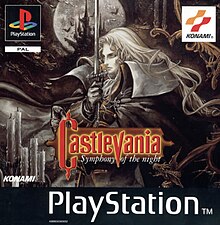 European packaging art featuring the game'south protagonist, Alucard, drawn by Ayami Kojima. | |
| Developer(s) | Konami Figurer Amusement Tokyo |
| Publisher(s) | Konami |
| Manager(s) | Toru Hagihara |
| Producer(south) | Toru Hagihara |
| Developer(s) |
|
| Creative person(due south) |
|
| Writer(s) |
|
| Composer(s) | Michiru Yamane |
| Serial | Castlevania |
| Platform(south) |
|
| Release | March 20, 1997
|
| Genre(southward) | Activeness role-playing, platform-adventure (Metroidvania) |
| Mode(s) | Single-player |
Castlevania: Symphony of the Night [a] [2] is an action part-playing game developed and published by Konami for the PlayStation.[three] It was directed and produced by Toru Hagihara, with Koji Igarashi acting as assistant director. Information technology is a direct sequel to Castlevania: Rondo of Blood, taking identify four years later. It features Dracula's dhampir son Alucard (returning from Castlevania III: Dracula's Curse) equally the protagonist, rise from his slumber to explore Dracula's castle which resurfaced after Richter Belmont vanished.[4] Its design marks a pause from previous entries in the series, re-introducing the exploration, nonlinear level design, and role-playing elements beginning experimented with in Castlevania Ii: Simon'southward Quest.[five]
Symphony of the Nighttime initially sold poorly. Still, it gradually gained sales through give-and-take-of-mouth and became a sleeper striking, developing a cult following and selling over 700,000 units in the United states of america and Japan. The game garnered widespread acclaim, often cited by critics equally ane of the best video games of all fourth dimension, praising its gameplay innovations, temper, visuals and soundtrack. Information technology is also considered a pioneer of the Metroidvania genre, inspiring numerous exploration-based action-run a risk games. Symphony of the Night would have a lasting touch on on the Castlevania series, with numerous subsequent mainline entries adopting its gameplay model.
Gameplay [edit]

The thespian, as Alucard, explores Dracula's castle – a large, interconnected surface area – and fights enemies on his way.
Symphony of the Night uses 2-dimensional side-scrolling gameplay.[6] The objective is exploring Dracula'due south castle to defeat an entity named Shaft who is controlling Richter Belmont, the self-proclaimed lord of the castle and hero of the events which took place in Castlevania: Rondo of Claret. Shaft can just be seen with a item item obtained during gameplay. Once he is defeated, the second portion of the game is revealed, an upside-down version of the showtime castle, with new enemies and bosses. Alucard has to find five specific bosses to collect five pieces of Dracula (in reference to Castlevania Ii: Simon'due south Quest), eventually leading to the final battle with a newly awakened Dracula.[5]
The game is not-linear, but most of the castle is inaccessible until various items and abilities are collected, including shapeshifting into a bat, wolf, or mist.[7] As the role player uncovers more of the castle, a map is updated to show progress.[eight]
While player characters in previous Castlevania games typically used a whip,[nine] the thespian can find and apply a broad diversity of weapons.[x] The game includes an inventory and other part-playing game elements.[viii]
Castlevania: Symphony of the Night incorporates elements found in part-playing video games. Alucard'southward hit points determine the maximum amount of damage he tin withstand before dying while his magic points make up one's mind how oftentimes a magical attack may be bandage. Alucard can besides collect hearts dropped from candles and enemies to employ sub-weapons like in previous games. Alucard has four other attributes: strength, the ability of his concrete assail; constitution, his resilience to damage inflicted past the monsters; intelligence, the power of magical attacks and sub-weapons; and luck, the frequency that items are dropped past enemies as well as the hazard to score a disquisitional hit.
Defeating monsters provides Alucard with feel points and he will level upwards afterwards reaching a predetermined amount, increasing his attributes in the procedure.[8] In improver to level-ups, Alucard can likewise detect Life Vessels and Heart Vessels scattered around the castle, which permanently increment Alucard's maximum hit points and hearts respectively. Alucard may bandage eight dissimilar spells, which requires the player to input directional combinations and volition use up varying amounts of his magic points.[8] During the course of the game, Alucard can acquire the ability to summon familiars, which function equally complementary entities, aiding him in battle and exploration.[ citation needed ]
Alternative modes of gameplay can be unlocked later on completion of the game. By inputting Richter Belmont's name equally the user name, the role player can play as Richter,[eleven] who uses a whip as his primary weapon and various sub-weapons.[ commendation needed ] In the Sega Saturn version, the port included in the PlayStation Portable game Castlevania: The Dracula X Chronicles, and in the PlayStation four port, Castlevania Requiem, Maria Renard is playable.[12]
Plot [edit]
Castlevania: Symphony of the Nighttime begins during the catastrophe of the previous game in the serial, Castlevania: Rondo of Claret, where Richter Belmont (Kiyoyuki Yanada / Scott McCulloch; David Vincent) confronts and defeats Count Dracula (Norio Wakamoto / Michael K.; Patrick Seitz).[xiii] Iv years after, in 1796, Richter goes missing and Dracula's castle reappears.[14] Alucard (Ryōtarō Okiayu / Robert Belgrade; Yuri Lowenthal) arrives at the castle to destroy it,[15] coming together Maria Renard (Chisa Yokoyama / Kimberly Forsythe; Michelle Ruff), who once fought aslope Richter and is searching for him.[sixteen] Alucard meets Richter, who claims to be the new lord of the castle.[17] Convinced that Richter is under somebody else'south control, Maria urges Alucard non to hurt him and gives him the Holy Glasses, which allows him to come across by illusions.[18] In the castle's go on, Alucard confronts Richter and learns that he plans to resurrect Dracula so the 2 tin can fight for an eternity.[xix] During a fight, Alucard breaks the spell controlling Richter, and Dracula's servant Shaft (Dai Matsumoto / Jeff Manning; Tony Oliver) appears and tells them that Dracula volition still be resurrected soon.[19]
Alucard leaves Richter and Maria to confront Shaft, venturing into an upside-down duplicate of the castle to seek him out.[19] Shaft reveals he planned to terminate the threat of the Belmont clan by controlling one of them and forcing the clan to fight ane another.[20] After defeating Shaft, Alucard faces his father, who vows to bring an end to humankind because Alucard'southward female parent Lisa (Rika Fukami / Alison Lester; Jessica Straus) was executed every bit a witch. Alucard refuses to join his father in his revenge and he defeats him.[twenty] Alucard tells Dracula that he has been thwarted many times considering he lost the power to dear after Lisa'south death, and that Lisa's final words were of eternal love for him and a plea not to hate or at least harm humanity. Before Dracula dies, he asks for Lisa's forgiveness and bids his son bye.[20]
After escaping the collapsing castle, Alucard rejoins Maria and Richter. Maria is relieved that he escaped while Richter blames himself every bit the reason for Alucard's fight with his father. Alucard tells Richter, "the only thing necessary for the triumph of evil is for practiced men to practise nothing", (a quote attributed to Edmund Burke) and resolves to disappear from the world because of his cursed bloodline.[21] Depending on how much of the castle the thespian has explored, Maria either chases Alucard in the promise of changing his mind, or resigns herself to Alucard's fate and leaves with Richter.[21]
Development [edit]
In 1994, development began on a Castlevania game for the Sega 32X, retroactively known under the title Castlevania: The Bloodletting. A playable epitome was created, only Konami decided to refocus its efforts on the PlayStation, and the game was cancelled as a result. Changes were made to these initial ideas, and the project became Symphony of the Nighttime.[22]
The game was directed and produced by Toru Hagihara, who had directed the previous entry, Rondo of Blood. Igarashi had creative influence and was involved with the story-writing and programming.[23] Part manner through product, Hagihara was promoted to head of the division and asked Igarashi to finish the game equally the assistant director.[24] From the outset, the game was intended to represent a new direction for the franchise. According to Igarashi, Castlevania: Symphony of the Night began evolution as "something of a side story for the series, we were able to break alot [sic] of Castlevania conventions and introduce a lot of new elements that we still use today".[25] Their chief motivation for the abrupt design alter was the sight of dozens of Castlevania games in bargain bins of Japanese video game stores; linear Castlevania games offered express replay value after completion.[26] A noted fan of 2d games, Igarashi was instrumental in refining the game'southward command scheme.[27]
Igarashi felt that regular activity games were too brusque, and he wanted to create a game that "could be enjoyed for a long time".[23] Consequently, the development team abandoned the traditional stage-by-stage progression of the previous Castlevania games in favor of an open castle that the player could freely explore. Igarashi looked to Nintendo's The Legend of Zelda series, which involved much exploration and backtracking to extend the amount of gameplay.[28] Igarashi was able to use the critical reaction from Castlevania Two: Simon's Quest, which was more than focused on exploration than action, to pitch Symphony of the Night to Konami.[29] The evolution team used inspiration from The Legend of Zelda to make most of the castle areas initially inaccessible to the role player.[28] The player would gradually obtain items and abilities that progressively opened up the castle. Their idea was to reward exploration while retaining the hack-and-slash activity of the previous games.[23]
Office-playing mechanics were added because Igarashi felt the earlier Castlevania games were too challenging for average players.[23] To modify that, the team implemented a leveling-upwards system with experience points, which rewarded players with better attack and defense statistics as they shell enemies. This system, combined with a multifariousness of items, armors, weapons and spells, immune the exploration to go less difficult for unskilled players.[23]
Symphony of the Night marked the debut of artist Ayami Kojima in the video game industry. She worked on the game as a character designer, conceptualizing the game's main and supporting bandage. Her designs for the game are heavily influenced past bishōnen-fashion art.[ commendation needed ] The game is presented using 2nd visuals, mainly sprites blithe over scrolling backgrounds. The PlayStation had no hardware for scrolling, which lead to the developers using the same methods for displaying character sprites to brandish the backgrounds.[30] Occasionally, the 3D capabilities of the PlayStation are utilized. The game contains opening and ending cinematics, which were created by another group at Konami. Igarashi and the development team were disappointed in the quality of the cine, which featured flat models lacking textures.[31]
Audio [edit]
The music used in Castlevania: Symphony of the Night was composed by Michiru Yamane.[32] The soundtrack contains elements from multiple musical genres, including classical, techno, gothic rock, new-age, jazz, and subgenres of metallic, specifically elements of thrash metal.[ commendation needed ] "I Am the Wind", a vocal catastrophe theme written by Rika Muranaka and Tony Haynes, and performed by Cynthia Harrell, is played during the credits.[ citation needed ]
Versions and re-releases [edit]
PlayStation and Saturn [edit]
Castlevania: Symphony of the Night was released in Japan on March 20, 1997, in North America on Oct 2, 1997, and in Europe in November 1997.[33] The Japanese release was packaged with an art book containing a small manga based on the game and a soundtrack compiled from almost of the previous Castlevania games.[34]
The North American and European version'due south localization was handled by Jeremy Blaustein, although he was non present for the voice recording.[35] Blaustein added the lines "What is a homo? A miserable little pile of secrets", which were taken from the novel Man's Fate by André Malraux.[31] Other changes fabricated in localization included AI improvements, the add-on of a sound exam, and the correction of a game-crashing bug found in the Japanese release.[36] The game was low-balled as a prospect for release in the The states, given relatively little advertising, received limited funding for its N American production, and was initially not a major financial success.[37] The game was re-released in Japan on the "PlayStation the Best" label on March 19, 1998, and in Northward America on "Greatest Hits" in 1998.[33] [37]
I understand why fans who've never played the Saturn version would be interested in those features, merely I really, really don't feel good about them. I couldn't put my name on that stuff and present information technology to Castlevania fans.
—Koji Igarashi, June 2007, on the Saturn port[38]
In 1998, a port of Castlevania: Symphony of the Night was released in Japan for the Sega Saturn. In this version, Maria Renard is both a fully playable character equally well every bit a boss fight, and Richter is available to play at the start of the game.[37] When playing the game as Alucard, a "third hand" is bachelor, but only for stat-altering items like food and potions and not weaponry. Alucard can use exclusive items, such as the Godspeed Boots, which grant him the ability to run like Richter.[ citation needed ] New areas, the Cursed Prison and the Underground Garden, which include new bosses, can be visited.[37] The port besides contains remixes of songs from previous Castlevania games.[39] Even so, loading is more than frequent and takes longer in the Saturn version than in other versions.[40] Because the Saturn has limited hardware transparency support, transparency effects such equally the mists and the waterfall were replaced with dithering furnishings,[41] though partial translucency does be in a few areas such as with Saturn sectional enemies and one of the final boss fights. Rather than taking advantage of the Saturn'southward increased resolution, the graphics were stretched to fill the screen, causing some sprites to be distorted. The overall quality of the Saturn port's video is said, according to Igarashi, to be lower than the PlayStation version considering it is a elementary port handled by another team and was not programmed to take advantage of the Saturn'due south second capabilities. Igarashi overall expressed disappointment with the Saturn version.[38]
Re-releases [edit]
In 2006, Konami announced that the PlayStation version of the game would exist ported to the Xbox 360, distributed via Xbox Live Arcade. The game was ported by Backbone Entertainment.[42] Information technology was the commencement Xbox Alive Arcade title to exceed the fifty MB file size brake for games on the service at the time. Xbox Live Arcade group manager Greg Canessa stated that an exception was fabricated for Symphony of the Night to "ensure that the gameplay experience is the all-time information technology can be".[43] This version was released on March 21, 2007.[44] As with near Xbox Alive Arcade games, Castlevania: Symphony of the Night features leaderboards that rails players' progress through the castle and features 12 achievements worth 200 points. To save infinite, all full motion video sequences were removed from the North American and European versions of the game. They have since been returned to the Japanese version, which is approximately 25 megabytes larger.[ commendation needed ] While the unpatched version on Xbox Alive Arcade nonetheless featured "I Am the Wind" equally the game's closing music, a later patch replaced information technology with "Admiration Towards the Clan", the closing song in Castlevania: Lament of Innocence due to licensing reasons.[ citation needed ] This patch as well stock-still a distorted background image in i ending. In 2009, Konami released Castlevania: Symphony of the Night alongside Super Contra and Frogger on the Konami Classics Vol. 1 compilation for Xbox 360.
Symphony of the Nighttime was re-released as a "PSone Classics" title on the PlayStation Network store on July nineteen, 2007, in North America, on December 16, 2010, in Japan, and on December 12, 2012, in Europe for utilize with the PlayStation 3, the PlayStation Portable, and the PlayStation Vita.[33]
A port of Symphony of the Night was included equally unlockable bonus content in Castlevania: The Dracula X Chronicles for the PlayStation Portable, which was released in N America on October 23, 2007, in Nihon on November 8, 2007, and in Europe on February 18, 2008. Except for the Japanese release, the English language translation features a new script and newly recorded vocalism acting, with the option to use the original Japanese voices.[45] The PSP release is a port of the PlayStation version, but contains some additions and changes. Maria Renard is a playable graphic symbol and a boss in this version, sporting a new moveset modeled afterward her abilities in Rondo of Claret.[12] Like the Xbox 360 version, "I Am the Wind" was replaced with "Mournful Serenade", a new slice composed by Michiru Yamane, as the endmost theme. An English language-recorded version of the song "Nocturne" was added forth with several familiars, both of which had been removed in previous international releases of the game.[46] The Dracula X Chronicles versions of Symphony of the Dark and Rondo of Blood were re-released for the PlayStation 4 on October 26, 2018 equally part of the Castlevania Requiem compilation.[47] Android and iOS ports of the game were released on March iv, 2020, based on the Dracula X Chronicles version.[48]
In 2010, Castlevania Puzzle: Encore of the Night, a puzzle game based on Symphony of the Night, was released for iOS.[49]
Reception [edit]
Castlevania: Symphony of the Night received broad critical acclaim at the time of its release. Critics lauded the massive, gratis-to-explore game world with its numerous secrets to uncover,[b] and praised the game for integrating role-playing elements without compromising the series' basic gameplay.[c] Multiple critics also made mention of the ingeniously designed enemies and the story's many plot twists.[d] GameSpot hailed it every bit "easily one of the best games ever released and a true testament to the fact that 2nd gaming is non dead by any stretch of the imagination."[61] Calculator and Video Games commented, "This may be old-skool manner, just it feels like the freshest affair of the year."[54] Next Generation stated that "Symphony of the Night has classic written all over it" and called it "spectacular" for a 2D side-scrolling platformer in the age of 32- and 64-bit games.[66] GamePro gave it a perfect 5.0 out of 5 in all iv categories (graphics, audio, control, and fun gene), calling it "one of the best games of the twelvemonth."[69]
Despite the popular consensus of the time that 2D had become outmoded, critics too highly praised the game's graphics for their smoothen animation, impressive effects, and evocation of atmosphere.[e] John Ricciardi of Electronic Gaming Monthly wrote that "everything is blithe with an astonishing attention to detail, and the special effects used throughout provide an atmosphere that just begs to exist experienced."[56] However, there were a few detractors of the use of 2D. Entertainment Weekly said that the visuals were dated and apartment, when compared to Nightmare Creatures which featured 3D environments,[lxx] while IGN commented, "The graphics are initially like-looking to SNES and Genesis incarnations of the game, the character animation isn't peculiarly smooth and 3D is resigned to express background effects and the odd special event."[64] A few criticized the voice acting, though GameSpot instead praised it.[f] The music was met with nearly unanimous approval, IGN describing information technology as "sometimes daunting, sometimes rousing and e'er doing what music should—enhancing the action."[m]
In Electronic Gaming Monthly 's Editors' Pick Awards, Castlevania: Symphony of the Night was awarded "PlayStation Game of the Year" and "Side-Scrolling Game of the Twelvemonth", and was a runner-upwardly for "Best Music" (behind PaRappa the Rapper) and "Game of the Year" (behind GoldenEye 007).[71] Information technology also was named "All-time Sequel" in their annual Buyer'southward Guide.[72] Information technology was named "Game of the Twelvemonth" by PSM in its list of the tiptop ten games of 1997.[ citation needed ]
Castlevania: Symphony of the Night received a nomination for "Console Adventure Game of the Yr" at the inaugural AIAS Interactive Achievement Awards (at present known every bit the D.I.C.Eastward. Awards).[73]
The game has developed a big cult post-obit and copies of the original PlayStation version are considered collector'southward items. Information technology demonstrated the continued popularity of second games during the 5th generation of video game consoles in the 32-bit era, which saw rapid advancements in 3D gaming.[37]
The game has continued to receive critical acclaim, and it has appeared on several other "greatest game" lists. The same year information technology was released, it was ranked the 12th best console video game of all time past Electronic Gaming Monthly, which said it "is non merely the all-time 2-D game on the PlayStation, it's one of the best, period."[74] Information technology appeared on GameSpot 's "The Greatest Games of All Time" list.[75] It was placed 16th on IGN'south "Top 100 Games of All Time"[76] and 24th in Game Informer 'southward "Pinnacle 200 Video Games Ever", down six places from its 2001 ranking.[77] [78] GameZone ranked it the all-time Castlevania title ever made.[79] GamePro listed the discovery of the inverted castle every bit the 26th-greatest moment in gaming.[80] GamesRadar named Castlevania: Symphony of the Night the second-all-time PlayStation game of all fourth dimension, behind Metallic Gear Solid.[81] It was ranked 4th identify on EGM'southward list of 100 greatest games of all fourth dimension, and was the highest PS1 game on the listing.[ commendation needed ] Border ranked the game No. 35 on its list of "The 100 Best Games To Play Today", stating "When you go to that moment when the castle turns on its caput, yous encounter that it's a work of genius".[82]
The gameplay of Castlevania: Symphony of the Night and its 2nd successors is oftentimes compared in the gaming press with the popular serial Metroid, with both Castlevania: Symphony of the Dark and Super Metroid seen as pioneers in the genre,[h] leading to the coinage of the term "Metroidvania" (a portmanteau of Metroid and Castlevania), used to describe video games that share some of their elements.[83]
Sales [edit]
Initially, the game's commercial performance was mediocre,[84] particularly in the United States where it was meagerly publicized, only thanks to praise by critics, information technology gained sales through word-of-rima oris and became a hitting.[37] The PlayStation and Saturn versions sold 225,862 units in Japan,[85] while the PlayStation version sold 477,304 units in the United States,[86] for a full of 703,166 units sold in the United States and Nihon.[85] [86]
Notes [edit]
- ^ Known in Japan as Akumajō Dracula Ten: Gekka no Yasōkyoku ( 悪魔城ドラキュラX 月下の夜想曲 , Akumajō Dorakyura Ekkusu: Gekka no Yasōkyoku , Demon Castle Dracula X: Nocturne in the Moonlight).[ane]
- ^ [54] [56] [61] [64] [66] [69]
- ^ [56] [61] [66]
- ^ [54] [56] [64] [61] [69]
- ^ [54] [56] [61] [64] [69]
- ^ [56] [66] [61]
- ^ [54] [56] [61] [64] [66] [69]
- ^ [54] [56] [66] [75]
References [edit]
- ^ Konami (2010-08-04). Castlevania: Harmony of Despair. Konami.
Japanese: 歴代の「悪魔城ドラキュラ」シリーズから選ばれた登場キャラクターを操作して、仲間たちと悪魔城に乗り込み、宿敵ドラキュラ伯爵に立ち向かおう。 English language translation: Accept control of by protagonists from the Castlevania serial to brave the Demon Castle alongside friends and defeat the ancient enemy Count Dracula.
- ^ Konami Computer Entertainment Tokyo (xx March 1997). Akumajō Dracula X: Gekka no Yasōkyoku. Konami Co., Ltd. Scene: staff credits.
- ^ a b "悪魔城ドラキュラX 〜月下の夜想曲〜 [PS] / ファミ通.com". Famitsu. Archived from the original on 2018-08-01. Retrieved 2018-07-24 .
- ^ Bozon, Marking (January 18, 2008). "Castlevania: The Retrospective – Page 4". IGN. Archived from the original on June 11, 2011. Retrieved September four, 2010.
- ^ a b Tieryas, Peter (Jan 15, 2018). "The Castlevania Game That Changed Everything". Kotaku. Archived from the original on 2018-01-xv. Retrieved 2021-02-04 .
- ^ Julian Rignall (1997-x-02). "Castlevania: Symphony of the Dark". IGN. Archived from the original on 2008-01-09. Retrieved 2007-11-07 .
- ^ "Castlevania Symphony of the Night: Classic Gameplay in a 32-Scrap World". Electronic Gaming Monthly. No. 95. Ziff Davis. June 1997. pp. 87–88.
- ^ a b c d Staff (1997-11-20). "Castlevania: Symphony of the Nighttime". GameSpot. CBS Interactive Inc. Archived from the original on 2008-12-08. Retrieved 2007-11-07 .
- ^ "Castlevania X: Moonlight Nocturne". GamePro. No. 100. IDG. January 1997. p. 48.
- ^ Matulef, Jeffrey. "Castlevania: Symphony of the Night turns 20 today". Eurogamer.internet. Archived from the original on 2017-11-27. Retrieved 2018-08-06 .
- ^ "South.Westward.A.T. Pro: Castlevania: Symphony of the Dark". GamePro. No. 108. IDG. September 1997. p. 134.
- ^ a b Doerr, N. "PSP Fanboy review: Castlevania Dracula X Chronicles". Engadget. Archived from the original on 2018-xi-11. Retrieved 2010-07-29 .
- ^ Low, David (2006-01-14). "Franchise Mode #11 – Castlevania, Part ane". PALGN. Archived from the original on 2012-10-08. Retrieved 2010-10-11 .
- ^ Konami (1997-03-20). Castlevania: Symphony of the Night. Konami. Level/area: Prologue.
- ^ Konami (1997-03-20). Castlevania: Symphony of the Night. Konami. Level/area: Marble Gallery.
- ^ Konami (1997-03-20). Castlevania: Symphony of the Dark. Konami. Level/area: Royal Chapel.
- ^ Konami (1997-03-20). Castlevania: Symphony of the Night. Konami. Level/surface area: Colosseum.
- ^ Konami (1997-03-20). Castlevania: Symphony of the Nighttime. Konami. Level/area: Castle Heart.
- ^ a b c Konami (1997-03-twenty). Castlevania: Symphony of the Night. Konami. Level/surface area: Castle Keep.
- ^ a b c Konami (1997-03-20). Castlevania: Symphony of the Night. Konami. Level/area: Inverted Castle Center.
- ^ a b Konami (1997-03-20). Castlevania: Symphony of the Night. Konami. Level/expanse: Ending.
- ^ "Tales From The Catacomb: Castlevania 20th Anniversary Blowout from 1UP.c…". archive.is. 2012-07-21. Archived from the original on 2012-07-21. Retrieved 2017-05-18 .
- ^ a b c d eastward McFerran, Damien (April 2007). "The Making of Castlevania: Symphony of the Night". Retro Gamer (36). Archived from the original on Feb i, 2013. Retrieved August 30, 2013.
- ^ "Gaming". Archived from the original on 2017-05-17. Retrieved 2017-05-fourteen .
- ^ Nintendo Power, July 2008
- ^ Thomas Shin (2007). Unpublished interview from Entertainment for All Expo 2007, Hardcore Gamer Magazine
- ^ "Koji Igarashi on Mastering Castlevania". Gamasutra. 17 May 2005. Archived from the original on 2007-11-03. Retrieved 2006-05-06 .
- ^ a b Matulef, Jeffery (2014-03-21). "Koji Igarashi says Castlevania: SotN was inspired by Zelda, not Metroid". Eurogamer. Archived from the original on 2014-03-22. Retrieved 2014-03-21 .
- ^ Oxford, Nadia (September 7, 2018). "Castlevania: Symphony of the Night Wouldn't Have Happened Without Castlevania 2: Simon's Quest". USGamer. Archived from the original on 2018-10-01. Retrieved September seven, 2018.
- ^ Symphony of the Night NTT-PUB official guidebook developer interview. 1997. Archived from the original on 2018-08-21. Retrieved 2018-08-thirty .
- ^ a b Oxford, Nadia (3 Oct 2017). "10 Things You lot Didn't Know About Castlevania: Symphony of the Dark". USgamer.internet. Archived from the original on 2018-08-06. Retrieved 2018-08-06 .
- ^ Deane, Donald (2013-10-04). "Ix Legitimately Awesome Video Game Soundtracks". Rolling Stone. Archived from the original on 2021-01-02. Retrieved 2021-01-02 .
- ^ a b c "Release Summary". GameSpot. CBS Interactive Inc. Archived from the original on 2013-01-23. Retrieved 2013-01-01 .
- ^ "Behind the Screens: Lucky Japanese". Electronic Gaming Monthly. Ziff Davis. June 1997. p. 88.
- ^ Blaustein, Jeremy (2019-07-18). "The baroque, true story of Metal Gear Solid'south English language translation". Polygon. Archived from the original on 2021-01-02. Retrieved 2021-01-02 .
- ^ "Castlevania: Symphony of the Night: A Moonlight Stroll with Alucard". Electronic Gaming Monthly. No. 99. Ziff Davis. Oct 1997. p. 164.
- ^ a b c d e f "The History of Castlevania". GameSpot. Archived from the original on 2009-06-17. Retrieved 2006-05-06 .
- ^ a b Loe, Casey (June 2007). "Castlevania The Dracula X Chronicles - A long-buried classic series rises once again". Play Magazine. United States of America: Fusion Publishing. pp. 31–40.
- ^ Low, David (2006-01-16). "Franchise Mode No. 11 – Castlevania". PALGN. p. ii. Archived from the original on 2012-10-08. Retrieved 2011-06-06 .
- ^ "Dracula Ten (review)". Game's Commonwealth. No. four. 1998. p. 84.
- ^ "Dracula X: Nocturne in the Moonlight (preview)". Electronic Gaming Monthly. No. 110. 1998. p. 102.
- ^ "Castlevania: SOTN". Games Marketplace – Xbox.com (Us version). Microsoft. Archived from the original on 2012-07-18. Retrieved 2012-12-03 . In "Overview (ii of 2)": "Developer: Digital Eclipse"
- ^ Sinclair, Brendan (2007). "Castlevania to break Alive Arcade size limitCastlevania to break Live Arcade size limit". GameSpot.com. Archived from the original on 2007-09-30. Retrieved 2007-07-18 .
- ^ "Castlevania: Symphony of Nighttime on Xbox Alive Arcade". xbox.com. Archived from the original on 2007-03-25. Retrieved 2007-03-21 .
- ^ "Castlevania: Dracula X Chr. 'Debut'". Archived from the original on 2007-09-27. Retrieved 2007-07-18 .
- ^ "Castlevania Symphony of the Night". VGMuseum.com. Archived from the original on 2008-07-27. Retrieved 2008-07-31 .
- ^ Alexander, Julia (2018-09-26). "Castlevania Requiem brings Symphony of the Night and Rondo of Blood to PS4". Polygon. Archived from the original on 2018-09-xxx. Retrieved 2018-10-02 .
- ^ Romano, Sal (2020-03-04). "Castlevania: Symphony of the Night now available for iOS, Android". Gematsu. Archived from the original on 2020-03-04. Retrieved 2020-03-04 .
- ^ Fletcher, JC (23 July 2010). "Castlevania Puzzle: Encore of the Night debuts on App Store". Archived from the original on 29 September 2010. Retrieved vi July 2012.
- ^ "Castlevania: Symphony of the Night for PlayStation Reviews". Metacritic. Archived from the original on 18 Dec 2011. Retrieved 18 December 2011.
- ^ "Castlevania: Symphony of the Night for Xbox 360 Reviews". Metacritic. Archived from the original on 19 April 2012. Retrieved eleven Apr 2012.
- ^ "Castlevania: Symphony of the Night for iPhone/iPad Reviews". Metacritic. Archived from the original on ii January 2021. Retrieved 4 December 2020.
- ^ "Castlevania: SOTN Review for PS1 from 1UP.com". 1UP.com. 9 May 2004. Archived from the original on half-dozen June 2012. Retrieved 11 Apr 2012.
- ^ a b c d e f g Huhtala, Alex; Davies, Paul (Nov 1997). "Castlevania: Symphony of the Night". Computer and Video Games. No. 192. pp. 76–77. Archived from the original on July 17, 2013. Retrieved January 13, 2020.
- ^ Edge staff (November 1997). "Castlevania: Symphony of the Nighttime (PS)". Edge. No. 51.
- ^ a b c d e f g h i "Review Crew: Castlevania: SotN". Electronic Gaming Monthly. No. 100. November 1997. p. 192. Archived from the original on 29 December 2003. Retrieved eleven Apr 2012.
- ^ Parkin, Simon (22 March 2007). "Castlevania: Symphony of the Night Review". Eurogamer. Archived from the original on eighteen February 2012. Retrieved 11 April 2012.
- ^ "Castlevania: Symphony of the Night". Game Informer. October 2007. pp. 46–47. Archived from the original on 22 February 1999. Retrieved 26 September 2012.
- ^ Baldric (October 1997). "Castlevania: Symphony of the Dark Review". Game Revolution. Archived from the original on 22 October 1997. Retrieved xi April 2012.
- ^ GameFan, volume v, issue ten (Oct 1997), pages xx & 84-85
- ^ a b c d due east f thousand h "Castlevania: Symphony of the Night Review (PS)". GameSpot. twenty November 1997. Archived from the original on 26 December 2013. Retrieved 11 April 2012.
- ^ Jeff Gerstmann (21 March 2007). "Castlevania: Symphony of the Dark Review (X360)". GameSpot. Archived from the original on 20 October 2013. Retrieved xi Apr 2012.
- ^ "R.I.P. PlayStation: The best of 1995-2001". Hyper. No. 90 (April 2001). 28 Feb 2001. pp. 44–51.
- ^ a b c d e f Julian Rignall (two October 1997). "Castlevania: Symphony of the Nighttime – PlayStation Review". IGN. Archived from the original on xx September 2012. Retrieved 11 April 2012.
- ^ Bozon, Mark (22 March 2007). "Castlevania: Symphony of the Dark Review – Xbox 360 Review". IGN. Archived from the original on 28 December 2012. Retrieved eleven Apr 2012.
- ^ a b c d eastward f chiliad "Finals". Side by side Generation. No. 36. Imagine Media. December 1997. p. 162.
- ^ "XBLA Review: Castlevania: Symphony of the Night". Official Xbox Magazine Britain. 21 March 2007. Archived from the original on 28 March 2007. Retrieved 11 April 2012.
- ^ Musgrave, Shaun (nine March 2020). "'Castlevania: Symphony of the Night' Review – It Volition Steal Your Soul". TouchArcade. Archived from the original on 17 March 2020. Retrieved eleven March 2020.
- ^ a b c d eastward Major Mike (September 1997). "Castlevania Mania". GamePro. No. 108. pp. 30–31. Archived from the original on 7 Jan 2006. Retrieved 11 April 2012. Full review appears only in printed version.
- ^ "PC Game Review: 'Nightmare Creatures' and 'Castlevania: Symphony Of The Night'". Entertainment Weekly. Archived from the original on 2015-10-16. Retrieved 2018-11-11 .
- ^ "Editors' Choice Awards". Electronic Gaming Monthly. No. 104. Ziff Davis. March 1998. pp. 86–96.
- ^ "The Skillful the Bad and the Silly". 1998 Video Game Buyer's Guide. Ziff Davis. March 1998. p. 28.
- ^ "Castlevania: Symphony of the Night". Academy of Interactive Arts & Sciences. Archived from the original on June 5, 2018. Retrieved April ten, 2020.
- ^ "100 Best Games of All Time". Electronic Gaming Monthly. No. 100. Ziff Davis. November 1997. p. 152. Note: Contrary to the title, the intro to the article (on page 100) explicitly states that the list covers console video games only, significant PC games and arcade games were not eligible.
- ^ a b Varanini, Giancarlo. "GameSpot Greatest Games of All Fourth dimension: Castlevania: Symphony of the Nighttime". GameSpot. Archived from the original on 2010-07-xvi. Retrieved 2007-06-13 .
- ^ "Top 100 games of All Fourth dimension (2005)". ign.com. Archived from the original on 2016-04-19. Retrieved 2006-05-06 .
- ^ Cork, Jeff (2009-11-xvi). "Game Informer's Summit 100 Games of All Time (Circa Result 100)". Game Informer. Archived from the original on 2010-04-08. Retrieved 2013-12-10 .
- ^ "Top 100 Video Games Ever". GI No. 100. Game Informer. 2001.
- ^ Workman, Robert (2011-09-27). "Happy 25th Birthday Castlevania: The 10 Best Games in the Series". GameZone. Archived from the original on 2013-12-11. Retrieved 2013-12-06 .
- ^ GamePro staff (2006-07-16). "The 55 Greatest Moments in Gaming (page five of 9)". GamePro. Archived from the original on 2011-06-07. Retrieved 2010-06-13 .
- ^ GamesRadar staff (November sixteen, 2012). "All-time PSX games of all fourth dimension". GamesRadar. Archived from the original on September 3, 2016. Retrieved Feb 2, 2013.
- ^ Edge Staff (2009-03-09). "The 100 Best Games To Play Today". Border Online. Archived from the original on 2014-10-29. Retrieved 2014-01-21 .
- ^ "Super Castlevania Iv Wii Virtual Console Review". ign.com. IGN Entertainment. Archived from the original on 2007-09-11. Retrieved 2007-06-13 .
- ^ Parish, Jeremy. "Sony PlayStation - Castlevania Symphony of the Night". Gaming Intelligence Agency. Archived from the original on 2012-07-06. Retrieved 30 October 2020.
- ^ a b "Game Search". Game Data Library. Famitsu. Archived from the original on 24 April 2019. Retrieved 25 Apr 2020.
- ^ a b "PS1 Us Sales from 1995-2003". Game Pilgrimage. NPD Grouping. Archived from the original on May 20, 2005. Retrieved xviii Oct 2020.
External links [edit]
- Castlevania: Symphony of the Dark at MobyGames
adamsfrouninclues.blogspot.com
Source: https://en.wikipedia.org/wiki/Castlevania:_Symphony_of_the_Night
0 Response to "Symphony of the Night Trevor Fight Castlevania Concept Art"
Post a Comment